Key Summary
- Poker is a strategic card game where players compare hands to win the pot. The best five-card hand forces opponents to fold.
- The game uses a standard 52-card deck, with most poker players accommodating 2-10 players.
- Each poker hand follows structured betting: pre-flop, flop, turn, river, and showdown. Forced blinds and antes make up the action, allowing players to check, bet, call, raise, fold, or go all-in.
- Table positions, hand rankings, and starting hand selection are crucial for success.
- Texas Hold’em is the most popular variant of poker. It uses hole and community cards players can use to make the strongest hand.
- Winning in poker consistently requires practice, discipline, bankroll management, avoiding beginner mistakes, and a balance of strategy and probability.
Arguably one of the world’s most popular card games, poker has found its spot as one of the top card games of all time. It’s most commonly played between friends or competitive players in tournaments with millions of dollars at stake for each round.
Poker rules may be complex for new players, but they’re otherwise easy to learn. Practicing poker goes a long way. It allows players to learn the rules, test poker strategies, and make the best plays for each round. We’ll cover the rules, strategies, and best poker variants such as No Limit Hold’em in the poker guide below.
What Is Poker and Why People Love It
Poker is a strategic and comparing card game often described as the right mix of skill and chance. Players wager on the value of their hands, which are compared in the end to determine the winner.
People love poker because of the variety of games and the social aspect. It’s easy to play between friends or with other competitive players. Poker fans can also enter various tournaments with massive prize pools if they’re looking for more than just the social aspect.
What You Need to Start Playing
When playing poker, you need a few things to start. Everything begins with a deck of cards, followed by the number of players and rules.
- Most games use a standard 52-card deck.
- The number of players varies between 2 and 10.
- The goal is to win the pot.
- In order to win, players need to have the best hand. Alternatively, the last player standing after others have folded wins the round.
Poker Rules Explained (Step-by-Step)
Let’s review the rules of poker and what’s important to begin playing.
The Setup
Small and big blinds are forced bets and a pillar of each variant. They’re quite common in the most popular poker variants, including Texas Hold’em and Omaha.
Each hand in poker begins with the big blind, which is typically left of the small blind. Both blinds determine the fixed betting amounts.
These bets are placed by two players, compared to antes that are placed by everyone. The blinds ensure there’s something in the pot that can be won for each hand.
The Deal
The deal begins when players have posted blinds, and starts with the dealer. It follows a specific sequence, ensuring that each game is fair.
The dealer will deal the cards clockwise, indicating who acts last during betting rounds. Players with the small blind receive cards first, while the dealer gets the last. Player positions are important in various poker strategies.
After everyone has the hole cards (the first two), the betting action begins. The first player to act is left of the big blind, a position known as under the gun.
This term describes the situation at that point – the first player has posted a blind, possibly ante, and a bet, and he’s under the most pressure due to having no idea what anyone else has.
Hole cards are only visible to each player, being facedown and invisible to their opponents.
Betting Rounds
A game of poker consists of several betting rounds. The deal won’t happen until ‘dead money’ is on the table, which includes the small and big blinds. It then continues with a pre-determined setup that starts with the pre-flop.
- Pre-flop: Cards are dealt one by one, starting with the player from the left and moving clockwise on the table. Depending on the variant, the pre-flop varies – in Texas Hold’em, players receive two cards, while in Omaha they get four hole cards.
- Flop: The pre-flop is followed by the flop. This is another betting round with three cards dealt face up. It begins with the player left of the dealer.
- Turn: Another card is dealt face up – also known as the turn. Another round of betting commences after it, again starting with the player left of the dealer.
- River: The fifth and final card is dealt face up. There’s another round of betting before the showdown.
- Showdown: The last step involves the comparing of the poker cards and the announcement of the winner of the round.
Legal Actions in Poker
As soon as the round is underway, players can use a variety of legal actions.
- Check: Stay in the round without betting more. It’s a low-risk action that allows you to see the next card.
- Bet: If you’re confident in your hand, you can make a bet of your choosing, ensuring that it covers the minimum.
- Call: Match the current bet, which keeps you in the round and lets you see where things go.
- Raise: Increase the bet, which might put pressure on opponents to fold or raise their bets too.
- Fold: An action that cuts your losses. Sometimes, it’s better to fold and step away from a weak hand.
- All-in: Invest all your chips. A high-risk action that can win it all or lead to a major loss.
Poker Hand Rankings (With Examples)
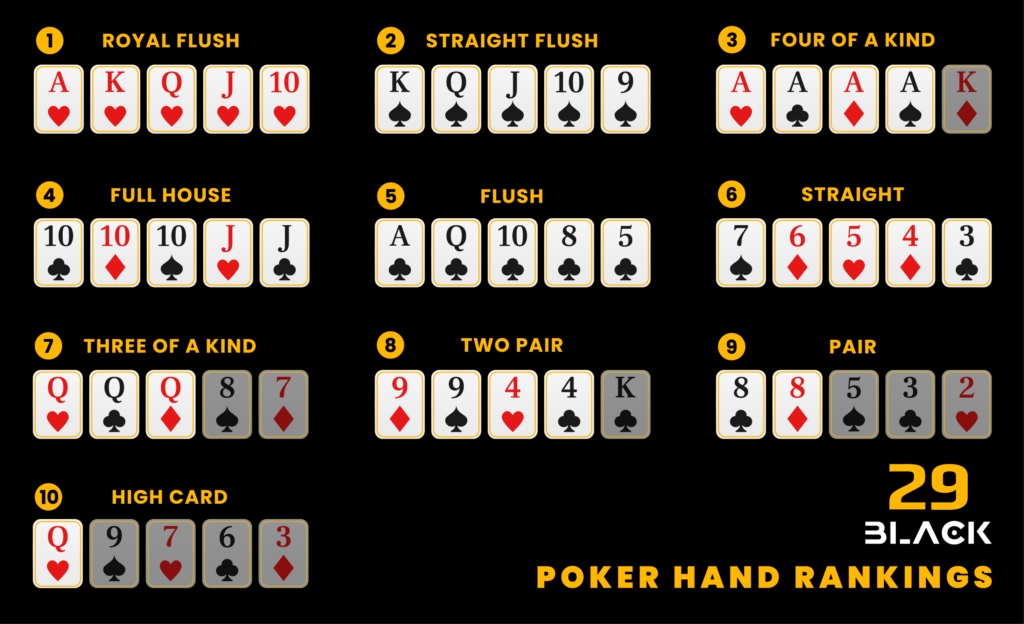
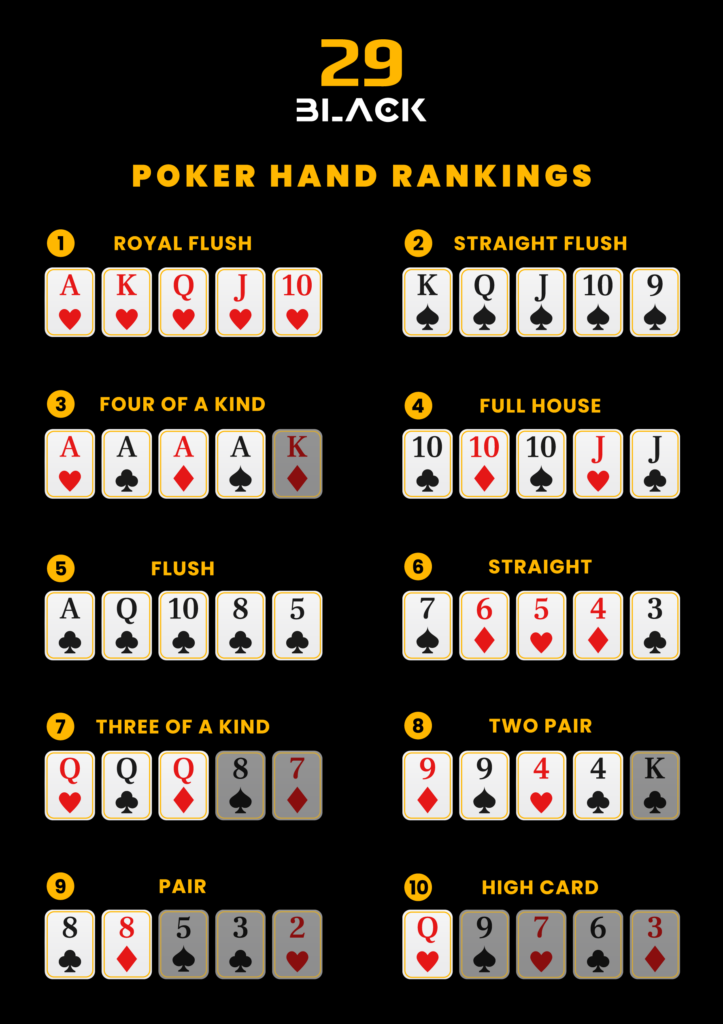
One of the first and most important steps of playing poker is to learn the hands and their rankings. For your convenience, we’ll rank them highest to lowest below:
- Royal Flush
- Straight Flush
- Four-of-a-Kind
- Full House
- Flush
- Straight
- Three-of-a-Kind
- Two Pair
- One Pair
- High Card
Overall, a Royal Flush beats everything on the table. High Card is the highest possible hand, and can be used if there are no other combinations possible on the table.
The Most Popular Poker Game: Texas Hold’em
Texas Hold’em is one of the most popular types of poker games. It’s the standard for most new and experienced players, and a common pick for poker tournaments.
In 2026, it’s widely regarded as the standard for most players. The game is easy to learn and has a faster pace than other poker variants.
How to Play Texas Hold’em in 5 Steps
The mechanics of Texas Hold’em are suitable for beginners. We’ll walk you through on how to play a round below.
- The round begins with two hole cards dealt to every player.
- Two players left of the dealer put in the blinds, then the action moves clockwise. Every player can call, raise, or fold their hand.
- Flop, Turn, and River follow – these are community cards placed in the center of the table.
- Players can then use a combination of their hole cards and the five community cards to make up the best five-card hand.
- The showdown starts, where hands for all players are compared to determine the winner. As always, the strongest hand wins the pot.
- Texas Hold’em differs from simpler poker variants in the community cards. Compared to Omaha, it uses fewer cards, which makes it easier to get into.
How a Poker Hand Actually Plays Out (Example Round)
A poker hand plays out very quickly. We’ll go over a round of Texas Hold’em as the most common game, so new players can get an idea of what happens during a round.
- The round begins with the blinds. The dealer deals cards clockwise, and two players left of him post the mandatory small and big blinds.
- A pre-flop stage begins, with two hold cards dealt to every player.
- Three community cards make up the flop, which is followed with a second betting round.
- During the Turn, a fourth community card is dealt. Another round of betting ensures.
- For the River, the fifth community card is added to the table face-up. The final betting round follows.
- If there are multiple players still in play, they reveal cards. They’re then compared and the strongest hand wins the pot.
Basic Poker Strategy for Beginners
Now that you know the hand rankings, you’re ready to begin your poker journey. Before making calls at the table, it would be wise to use a poker strategy.
Poker’s not just about the cards – it’s how you assess and play every hand.
1. Starting Hand Selection
In a game of Texas Hold’em, most initially dealt hands are weak. This leads to early folds, unless players are lucky enough to get high pairs or high-value connectors (like A-K suited).
Hands such as J-4 or 7-2 offsuit are hard to improve. Players who don’t fold them early usually lose a lot of money.
2. Understanding Position
The position in Texas Hold’em has a strong impact on how the actual round plays out. In some cases, it’s even more important than the hands themselves.
Players in the early position (under the gun, left of the big blind) must stay vigilant. They play first without knowing what others have. In this case, only premium hands can do some damage.
In the middle position, players have a bit more leeway. They must still be cautious because there are players with calls after their position.
Late positions can play more aggressively. They already know what others hand, and can act accordingly.
The button is the best seat in a game of Texas Hold’em. These players can see how others react before putting a chip into the pot.
3. Betting Fundamentals
Playing poker successfully means learning the betting fundamentals. For strong hands, it’s betting to get value. This means letting players with worse hands call. If you have a strong hand, the best possible action is to bet big, as playing slow gives your opponents a chance to outdraw.
Bluffing may be a bit too much for new players, but it’s an effective technique. When the board is scary, it can be a useful tool to defeat the others at the table. But players should keep in mind that sometimes, a bluff on players who refuse to fold can backfire.
It’s always best to go with a balanced approach and follow what others have closely. By playing responsibly, you can manage your bankroll and decide what’s best for each round, which means learning when to fold and when to bet big.
Common Poker Mistakes New Players Make
New players may make a few mistakes that are easy to iron out. We’ll cover a few of them players should avoid when playing a poker game.
Never play too many hands at once. Instead, beginners should stick to one. It makes things much simpler and allows you to learn more about the game.
Ignoring the position is another mistake new poker players make. As pointed out earlier, the Under the Gun position should be avoided as it doesn’t give you leverage over other players.
Calling too often may be appealing to some players, but it often drains the bankroll. Unless you have a very strong hand, you should stay disciplined with your bets.
Like with any other casino game, playing responsibly is a must. Make sure to manage your bankroll and start with small bets, and avoid chasing losses, as you may never catch up.
Basic Poker Odds & Probability (Beginner-Friendly)
Beginners need to understand a few things about the game of poker before they start. First up are the pot odds. Think of them as the price the pot offers when you make a call. If there’s $50 in the pot and the opponent calls it, the total pot is $100. In most cases, players need to match that amount to see the next card.
Pot odds also give players an idea of what they do with the hand they have. If it’s good, the odds of winning the hand are much better than the price on offer, requiring a call.
When drawing hands, it doesn’t automatically spell a win. With the right card on the board, players can make a strong hand. For example, if they have four cards of the same suit, they need one for a Flush.
This means there are nine outs, or cards in the deck left to help you. This means doing some math, but once you get the hang of it, it becomes simple to calculate your odds.
The world’s best poker players rely on pattern recognition instead of being a math whizz. Keep an eye on the table, memorize how frequently some cards land, read your opponents, and don’t forget to practice and be patient. With this, you’ll be able to tell the odds and probability for each hand regularly.
Poker Etiquette & Table Rules You Should Know
When playing poker, you need to stick to some etiquette or rules. This includes acting only when it’s your turn, protecting your hand, and never discussing hands in progress.
If you’re chatting, keep things civil. Sometimes, bad beats happen, and there’s no need to point out everyone’s mistakes.
Another thing to avoid is a slow roll. If you have a winning hand, don’t wait for the last second to call. This is considered rude and poor sportsmanship, and may even be a result for a kick off the table.
What are the Different Variations of Poker?
There are dozens of variants of poker, differing in game speed and slightly altered win rules. We’ll group them into four major categories.
Community Card Poker Games
These games have private hole cards and face-up cards in the center. The most popular variants are Texas Hold’em and Omaha.
Draw Games
In draw poker games, players are dealt a full five-card hand. They can discard some cards and draw new ones. The most popular variants are Badugi, 2-7 Triple Draw, and Five-Card Draw.
Stud Games
Players receive hole cards and face-up cards dealt specifically to each one during the hand. Most popular variants are Five-Card Stud, Seven-Card Stud, and Razz.
Mixed and Split-Pot Games
These games combine different poker rules. Prizes are split between the top and lowest-ranking hands. Popular variants include H.O.R.S.E, Mixed Triple Draw, and Eight-or-Better.
Online Poker vs Live Poker: What’s Different?
Online poker and live poker differ in a few things. Their nature is the largest difference – online poker is played against a virtual dealer, while live poker games are played against human-dealer in real-time.
This impacts the speed of play, tells, betting patterns, and bankroll considerations. Live poker is also not available for free. For beginners, it’s best to go with online poker games in order to learn the poker rules and deploy strategies.
Live dealer poker games are better for experienced players, as everything happens in real time and requires faster reactions.
How to Practice and Improve at Poker
Mastering the game of poker requires a lot of practice. The good news is that you can practice for free with poker games and apps. This will give you an advantage of learning the rules, and possibly creating a poker strategy that holds up.
By playing for free, you can review the rules, hands and learn from mistakes. No need to pay for a poker coach. Another option is to play low-stakes games. They won’t drain your budget in case of mistakes, and will give you the low-down on playing poker like a pro.
FAQ
Is poker more luck or skill?
Poker is a game that mixes both. It’s a game of skill, but a bit of luck with a good draw goes a long way toward winning.
What is 5-6-7-8-9 in poker?
A 5-6-7-8-9 hand in poker, or five cards in numerical sequence of the same suit, is a Straight Flush. If the cards are in different suits, it’s simply a Straight.
What is “bluffing” in poker?
Bluffing is a psychological poker strategy, which sees players trying to convince their opponents they have a stronger or weaker hand than the actual cards.
What is the 50% rule in poker?
The 50% rule means that players who raise 50% or more of the largest bet prior to it must make a full minimum raise.
What does “check” mean in poker?
The term check in poker means passing the action to the next player without a bet. It’s one of the four basic moves in the game.
How long does it take to learn poker?
Poker can be mastered in a few months. It requires a lot of focus, practice, and patience to learn how to play each hand optimally.
Can you make money playing poker?
Yes, you can make money by playing poker. But before engaging in real money poker, we suggest going through the basics with free poker games to learn the rules and how to play.
What’s the easiest poker game to learn?
Texas Hold’em provides the perfect balance between tracking a few cards and having decent entry fees. It still requires a lot of mastering, so keep practicing until you learn how to play it.
Final Thoughts
Poker is an exciting and rewarding game to play no matter the variant. Texas Hold’em is the most popular one, and the one that’s easiest to learn.
Practice and patience make perfect when it comes to poker games. Even for beginners, practicing by trial and error can provide a lot of insight into the poker rules, and help you devise strategies that work.
Play the top poker games at 29Black, making your pick between demo poker variants for beginners, or the top live poker games for experienced players.